
Shrinkage Management: How to Reduce Losses in Your Store
What does shrinkage mean in retail?
Shrinkage refers to the difference between the recorded inventory balance and the actual physical inventory. When you count the products on your shelves and compare to the system, the gap is shrinkage. It is money that has disappeared -- but never made it to the register.
In Finland, the average retail shrinkage rate is about 1--2% of revenue. That sounds small, but with annual revenue of EUR 500,000, it means EUR 5,000--10,000 per year -- pure loss that directly eats into your margins.
If your store revenue is EUR 500,000 and your shrinkage rate is 1.5%, you lose EUR 7,500 per year. That equals several months of rent or an extra part-time employee salary.
Shrinkage types and their share
Shrinkage does not come from a single source. It consists of several different factors, each requiring its own approach. The table below describes the most common shrinkage types and their typical share of total shrinkage.
| Shrinkage type | Description | Share of total shrinkage |
|---|---|---|
| Theft (customer and employee theft) | In addition to shoplifting, internal theft is surprisingly common. Employee-caused shrinkage can be hard to detect without systematic monitoring. | 35--40% |
| Administrative errors | Wrong quantities recorded, receiving checks skipped, and pricing mistakes. Often the single biggest correctable cause. | 20--25% |
| Damage and spoilage | Broken items, expired products, and transport damage. Especially significant in stores selling fresh goods. | 20--25% |
| Operational errors | Unrecorded markdowns, incorrectly processed returns, and transfer errors between stores. | ~10% |
| Supplier fraud/errors | Short shipments, wrong products sent, or invoicing errors. Less frequent cause, but amounts can be large. | 5--10% |
How to measure shrinkage rate?
Calculating the shrinkage rate is straightforward: (Recorded inventory - Actual inventory) / Recorded inventory x 100. The result gives you the percentage shrinkage rate. If your system shows 1,000 units but your count finds only 980, your shrinkage rate is 2%.
Formula: Shrinkage rate (%) = (Recorded inventory - Actual inventory) / Recorded inventory x 100. Calculate per product category to quickly find problem areas.
The key is to measure regularly -- do not wait for the annual inventory count. The more often you count, the faster you detect deviations and can react.
6 practical ways to reduce shrinkage
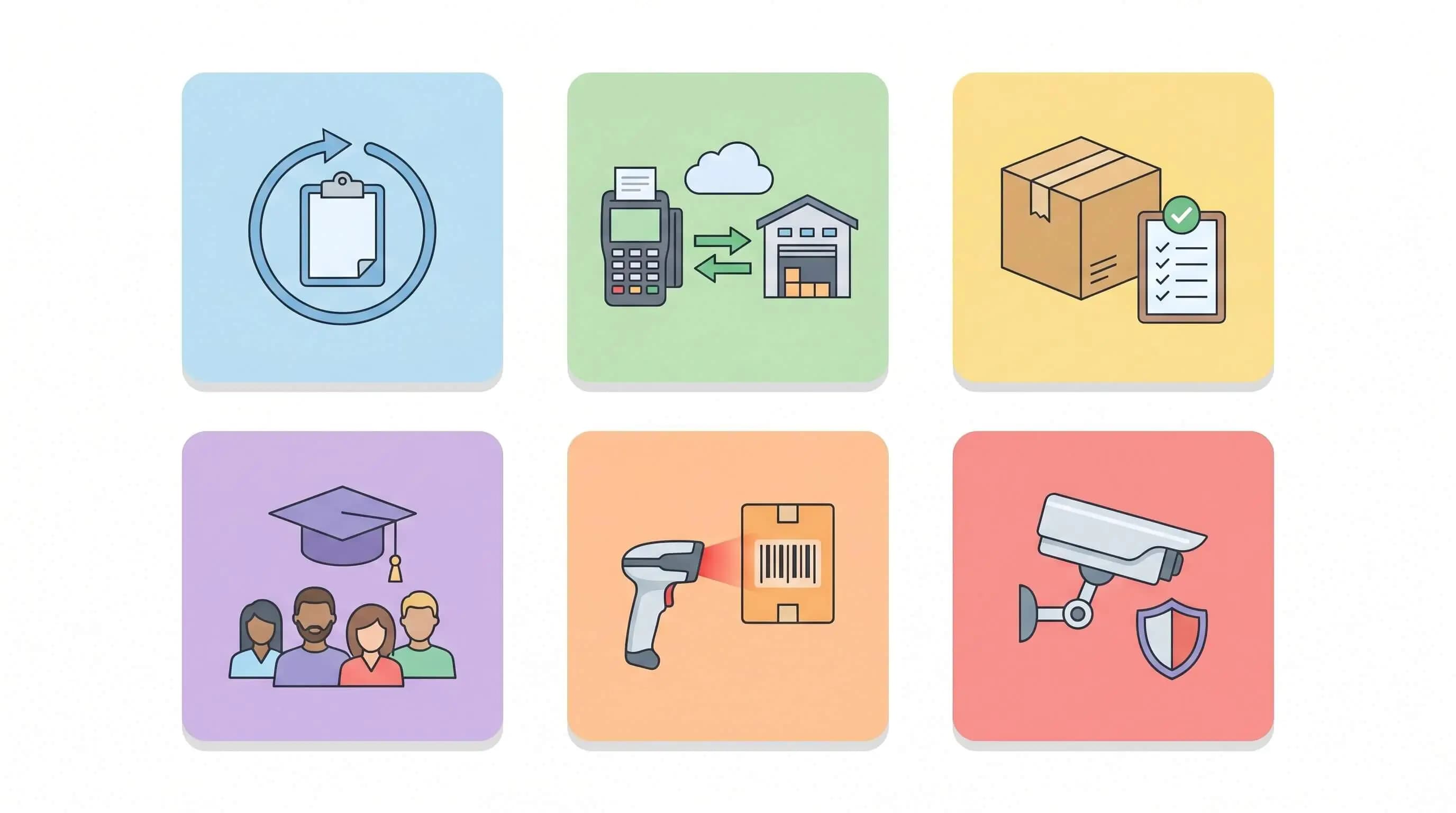
Shrinkage does not disappear on its own. It requires systematic work and the right tools. Here are six practical measures that work in Finnish retail.
Regular cycle counting
Do not rely on annual inventory alone. Count small product groups weekly so errors are found early and do not accumulate for the entire year.
POS-inventory integration
When POS and inventory update in real time, balance errors decrease immediately. Every sale, return, and transfer is visible instantly.
Receiving verification
Count and check every delivery. Compare the packing list to actual contents before confirming receipt in the system.
Staff training
Train staff to understand the impact of shrinkage and correct procedures. An aware team makes fewer errors and notices anomalies.
Barcode scanning
Barcode use eliminates manual entry errors. Scanning products at receiving, sales, and inventory significantly improves accuracy.
Security and clear processes
Cameras, EAS tags, and clear return and markdown policies reduce both theft shrinkage and operational errors.
How does inventory software catch shrinkage early?
Without software, shrinkage is often noticed only during annual inventory -- months after the events occurred. Modern inventory management software brings three critical features for combating shrinkage.
- Variance reports: The system automatically compares recorded balances to actuals and highlights products where the difference exceeds a set threshold.
- Automatic shrinkage alerts: When a balance changes unexpectedly -- for example, products disappear without a sales transaction -- you receive an alert immediately.
- Audit trail: Every balance change is logged -- who did it, what was done, and when. This makes investigating the root causes of shrinkage possible.
How does Inventa help with shrinkage management?
Inventa is designed specifically for Finnish retail needs. It combines real-time inventory tracking, barcode scanning, and clear reports in one easy-to-use system -- so shrinkage cannot accumulate unnoticed.
Real-time tracking
Every sale, receipt, and transfer updates balances instantly. No more unclear balances or day-long delays.
Barcode scanning
Scan products at receiving and inventory with a mobile device. Manual entry errors become a thing of the past.
Adjustment logging
All balance adjustments are logged with reasons. See who adjusted, what, and why -- full audit trail.
Variance reports
Clear reports show where shrinkage occurs. Find problem products and areas before losses grow.
Summary: shrinkage management is continuous work
Shrinkage is an inevitable part of retail, but you can influence its magnitude. Start by measuring: determine your shrinkage rate by product category. Implement regular cycle counts, ensure receiving verifications, and invest in a system that shows variances in real time. Even small improvements yield results -- a 0.5 percentage point improvement on EUR 500,000 revenue saves EUR 2,500 per year.
Want to see how Inventa helps with shrinkage management? Try a free demo.
Related Articles
Retail Inventory Management: A Guide for Merchants
Comprehensive guide to retail inventory management. POS integration, shrinkage prevention, multi-location challenges, seasonal planning, and Finnish-specific requirements.
POS System and Inventory Management: Why They Belong Together
Disconnected POS and inventory systems cause errors, overselling, and wasted time. Learn how POS-inventory integration works and what benefits it brings.
Multi-Location Inventory: Manage Multiple Locations from One Place
Multi-location inventory management is essential for growing businesses. Learn to manage multiple warehouses, stores, or departments centrally -- transfers, replenishment, and reporting from one view.