
POS System and Inventory Management: Why They Belong Together
Disconnected POS and inventory -- a familiar problem
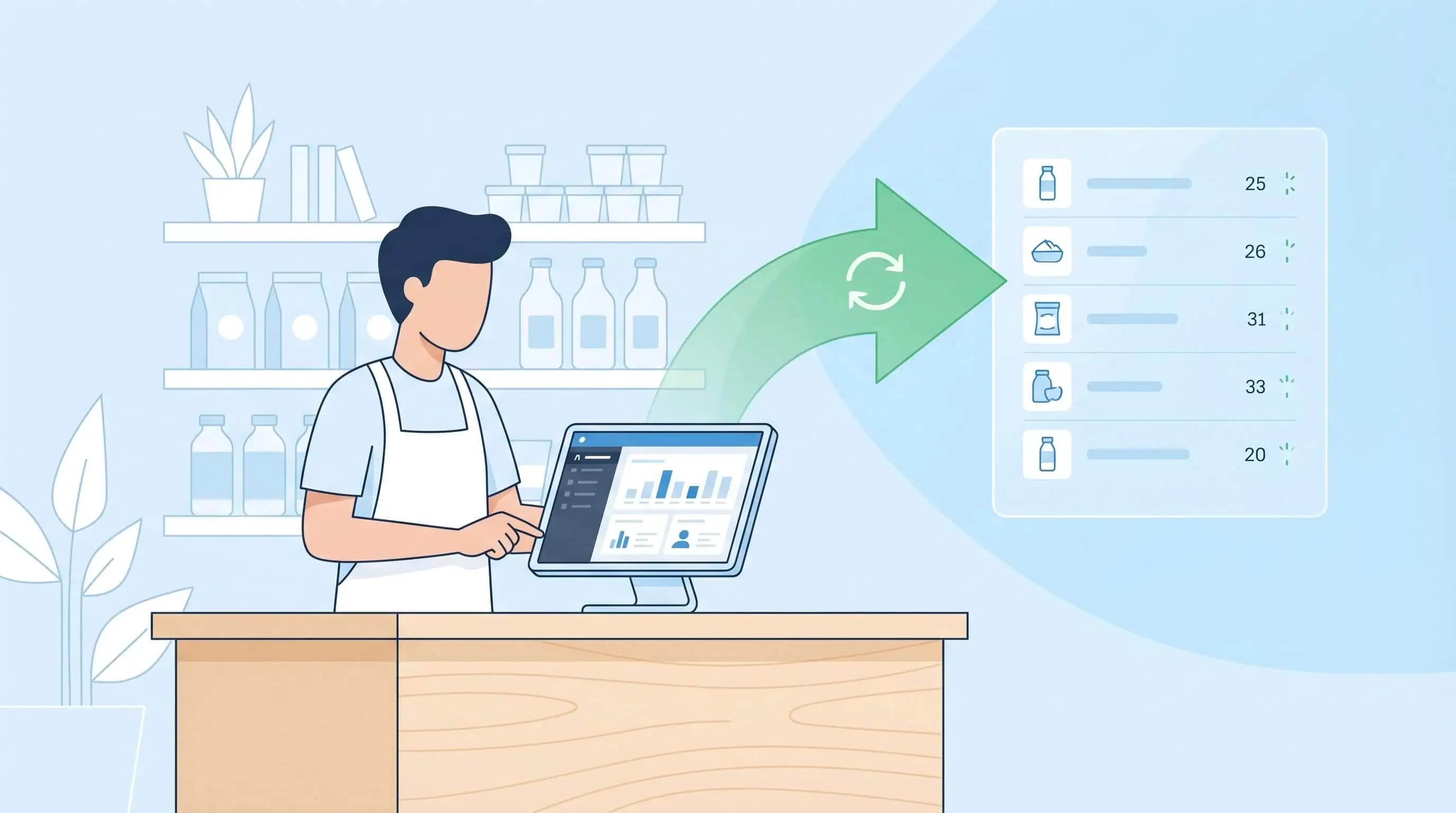
In many Finnish retail stores, the POS and inventory live separate lives. Cashiers ring up products, but stock levels update only in the evening -- or worse, the next day. The result is inaccurate data, overselling, and unnecessary stock checks.
This is not just an efficiency problem -- it directly impacts customer experience. When a customer orders a product online that was already sold in-store, disappointment follows and trust in the store erodes.
- Stock levels do not match reality
- Overselling in the online store or physical store
- Manual stock updates take time and cause errors
- Staff spend time on checks instead of selling
How does POS-inventory integration work?
In an integrated system, each POS transaction deducts stock in real time. When a cashier sells a product, the balance updates instantly -- in-store, online, and across all channels. No waiting for nightly syncs or spreadsheet transfers.
In practice: a customer buys a product in the Helsinki store, and the online stock updates at the same moment. Another customer in Oulu sees the correct availability instantly. This is the foundation of omnichannel retail.
Real-time sync is not just about recording sales -- returns, receiving, and transfers also update balances automatically.
Practical benefits of integration
Accurate stock levels
Stock levels match reality at every moment, across all channels.
No overselling
When stock updates in real time, products cannot be sold beyond what is available.
Time saved
Manual stock checks and updates become a thing of the past.
Better customer experience
Customers can trust availability information -- in-store and online.
Better reporting
Combined data gives you a clear picture of sales, margins, and turnover rates.
Barcode support
Products are identified by barcode at the POS and in the warehouse -- fast and error-free.
VAT handling in a POS system
In Finland, value-added tax (ALV/VAT) is an essential part of any POS system. Different product groups have different tax rates, and the POS must handle all of them correctly -- on every receipt, in every sale.
| VAT rate | Percentage | Example products |
|---|---|---|
| General | 25.5% | Clothing, electronics, cosmetics |
| Reduced | 14% | Groceries, restaurant food |
| Reduced | 10% | Books, medicines, sports services |
| Zero rate | 0% | Exports outside the EU |
If your POS system does not support all VAT rates, you risk recording taxes incorrectly. This can lead to issues in tax audits and unnecessary additional investigations.
Cash rounding: The 5-cent rule
In Finland, 1 and 2 cent coins are no longer in circulation. When a customer pays with cash, the total is rounded to the nearest 5 cents. For example, EUR 14.92 rounds down to EUR 14.90, and EUR 14.93 rounds up to EUR 14.95.
A good POS system handles this automatically for cash payments while preserving the exact amount for card payments. This is a small but important detail that prevents errors in the daily closing.
Omnichannel: Physical store and online store from the same inventory
More and more Finnish merchants sell both in-store and online -- for example via Shopify. Without integration, the merchant must maintain two separate inventories or update stock manually between channels. Learn more about Shopify inventory management.
In an integrated solution, the physical store and online store share the same inventory. When a product is sold in-store, the Shopify balance updates. When an online order comes in, the store balance decreases. This eliminates overselling risk and enables reliable Click & Collect. If you have multiple locations, also explore multi-location inventory management.
Omnichannel does not just mean having an online store and a physical store -- it means they work together seamlessly. Same product, same stock, different channels.
What to look for in a POS + inventory solution?
When evaluating different options, pay attention to these features:
- Real-time sync between POS and inventory -- no nightly or daily updates
- Multi-location management -- support for multiple stores and warehouses in the same system
- Full support for Finnish VAT rates (25.5%, 14%, 10%, 0%)
- Automatic cash rounding to 5 cents
- Barcode scanner and product search at the POS
- Reporting: sales, margins, turnover rates, and alerts
- E-commerce integration (e.g. Shopify)
How does Inventa connect POS and inventory management?
Inventa is designed from the ground up so that POS and inventory are part of the same system. No separate integration, no third-party middleware -- just one shared truth about your stock levels.
Real-time stock update
Every POS transaction updates stock levels instantly. Store, online shop, and warehouses stay in sync.
Multi-location management
Manage multiple stores and warehouses from one view. Transfer products between locations with a few clicks.
Finnish VAT and rounding
All VAT rates (25.5%, 14%, 10%, 0%) and automatic cash rounding to 5 cents are included.
Shopify integration
Connect your online store to Inventa and manage all channels from one place -- without manual stock work.
Inventa's POS is optimized for tablet use and works offline as well. The dark theme reduces eye strain during long shifts, and large buttons speed up work. When connectivity returns, transactions sync automatically.
Summary
A POS system and inventory management are not two separate things -- they are two sides of the same coin. When they work together, you get accurate stock levels, fewer errors, better customer experience, and more time to focus on growing your business. In Finnish retail, this also means proper VAT handling, cash rounding compliance, and omnichannel readiness. Also read about inventory management trends for 2026-2027.
Want to see how Inventa connects POS and inventory?
Related Articles
Retail Inventory Management: A Guide for Merchants
Comprehensive guide to retail inventory management. POS integration, shrinkage prevention, multi-location challenges, seasonal planning, and Finnish-specific requirements.
Shrinkage Management: How to Reduce Losses in Your Store
Shrinkage costs Finnish retailers thousands of euros per year. Learn to identify shrinkage types, measure your shrinkage rate, and prevent losses in practice.
Multi-Location Inventory: Manage Multiple Locations from One Place
Multi-location inventory management is essential for growing businesses. Learn to manage multiple warehouses, stores, or departments centrally -- transfers, replenishment, and reporting from one view.